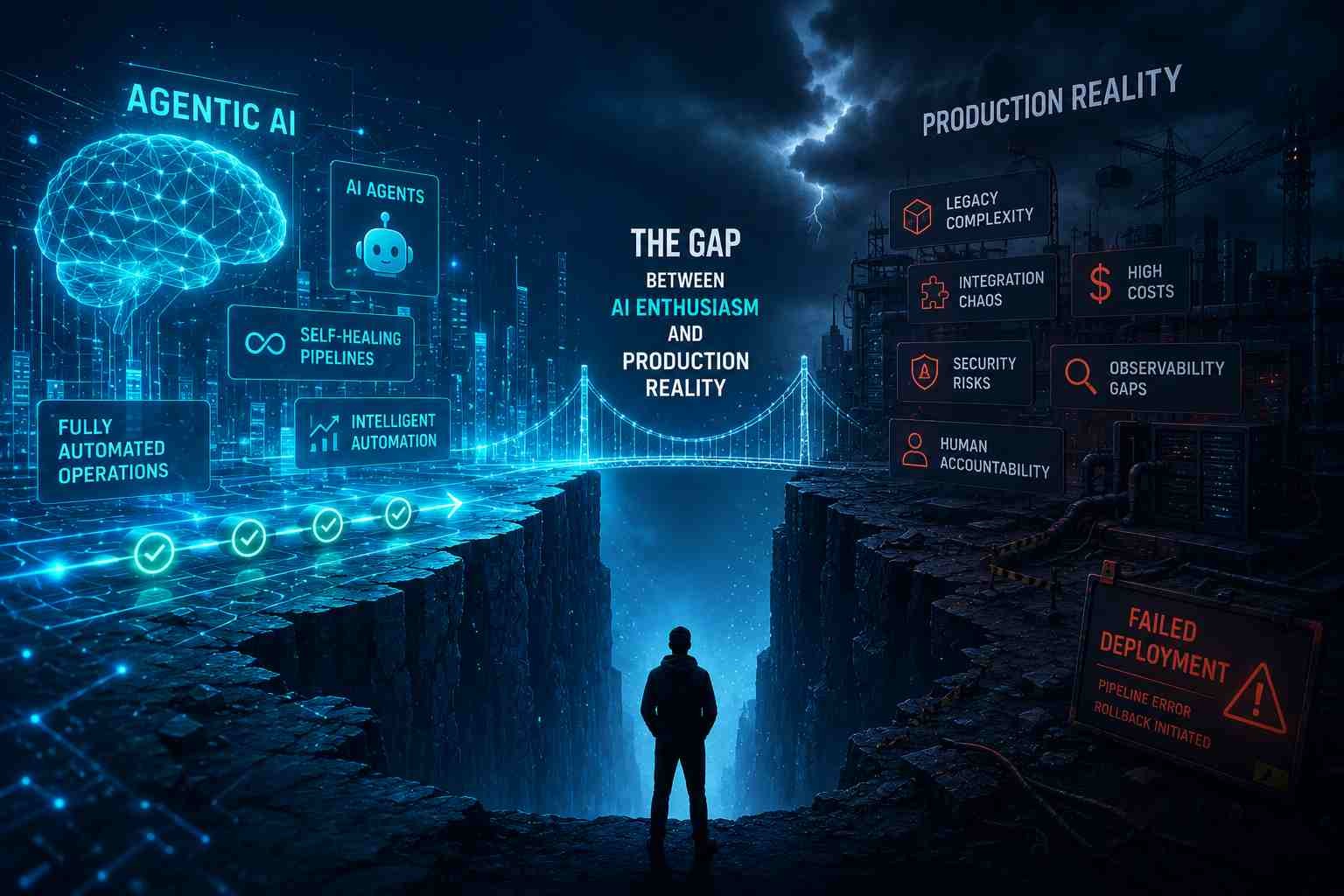
The Gap Between AI Enthusiasm and Production Reality in DevOps
The excitement around Agentic AI and AI-powered tools in DevOps is undeniable. Conferences, LinkedIn posts, and vendor presentations paint a picture of seamless automation, self-healing pipelines, and intelligent agents handling complex operations with minimal human intervention.
Yet, behind the hype, a different story is unfolding in engineering teams across the globe. Many organizations that enthusiastically adopted AI initiatives in DevOps are now facing significant challenges when moving from proof-of-concept to production environments.
This article explores the real gap between AI enthusiasm and production reality, drawing lessons from actual projects in 2025–2026.
1. The Hype vs Reality Disconnect
The promise is compelling: AI agents that can autonomously debug issues, optimize CI/CD pipelines, manage infrastructure, and even respond to security incidents in real time.
In practice, many teams discover that:
- Prototypes work beautifully in controlled environments
- Production environments are messy, unpredictable, and full of legacy complexity
- The cost, reliability, and security implications are often underestimated
One of the most common patterns observed is the “Pilot-to-Production Death Valley” where initiatives that looked extremely promising in demos struggle or fail once exposed to real traffic, real data, and real business consequences.
2. Key Gaps That Most Teams Face
Observability & Debugging Challenges
When an autonomous AI agent makes a decision that causes unexpected behavior in a pipeline, traditional monitoring tools often fail to provide clear answers. Questions like “Why did the agent choose this action?” or “What was its reasoning chain?” remain difficult to answer without proper observability design.
Security and Compliance Risks
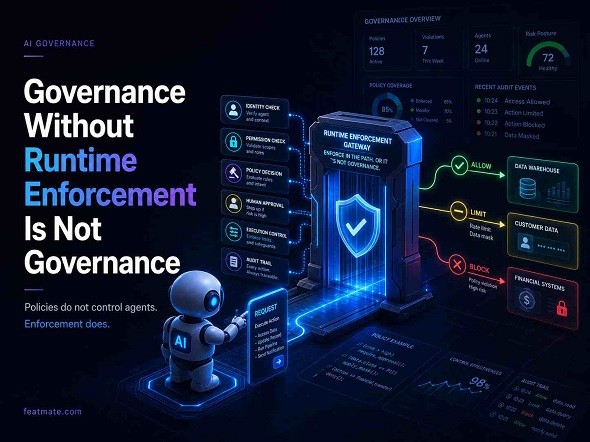
Agentic systems that can modify infrastructure, run commands, or access sensitive data significantly expand the attack surface. Traditional security controls designed for static applications are frequently insufficient for dynamic, autonomous agents.
Cost Overruns
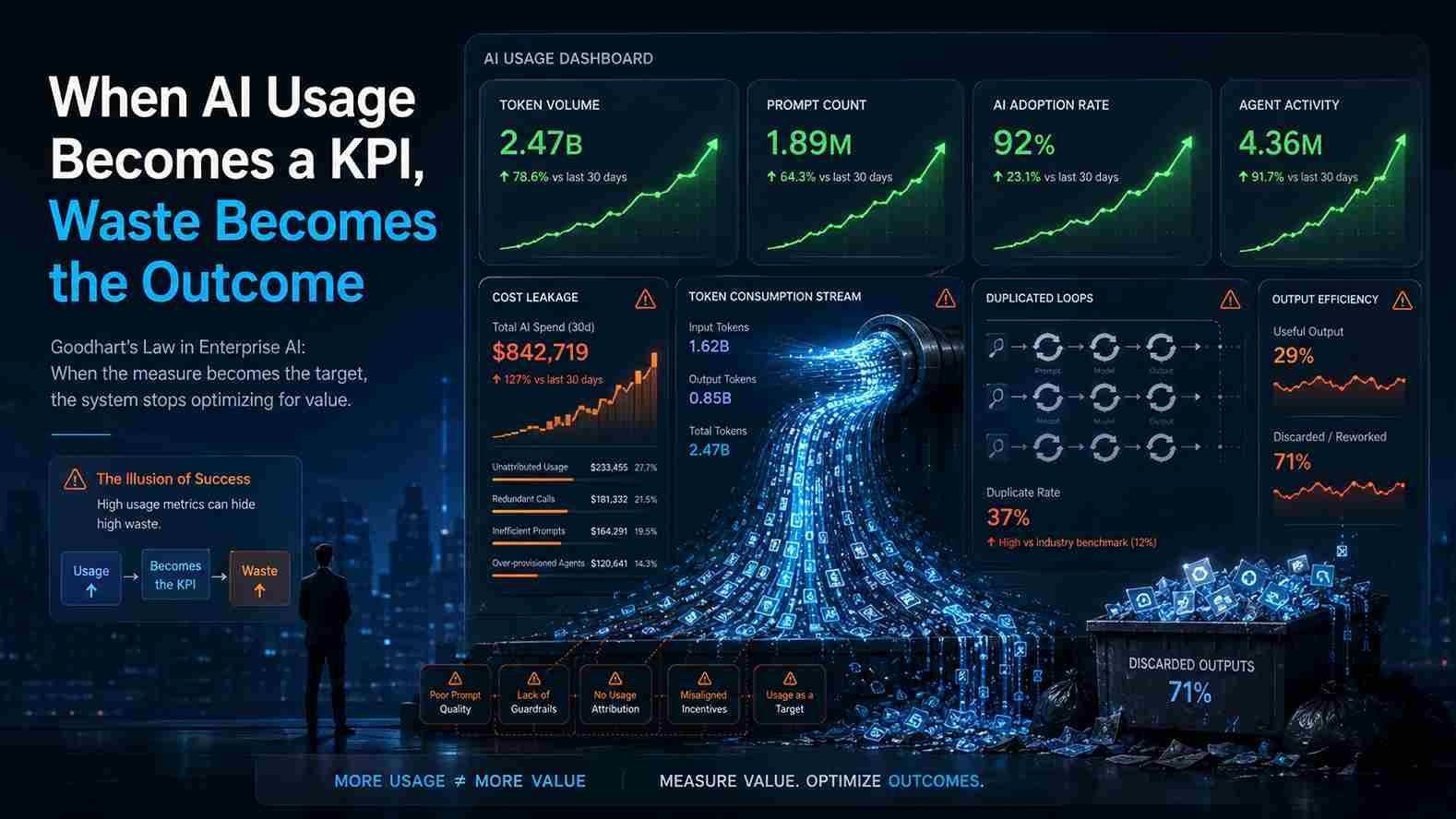
Many teams report LLM costs that are 5x to 15x higher than initially projected once agents begin making frequent tool calls and running complex reasoning loops in production.
Human Accountability
When an AI agent causes downtime or a security breach, who is ultimately responsible? The lack of clear accountability frameworks creates hesitation among leadership and slows down adoption.
Integration Complexity
Most enterprises still operate with a complex mix of Kubernetes clusters, legacy systems, Terraform configurations, custom scripts, and multiple cloud providers. Reliably connecting intelligent agents to this heterogeneous environment remains one of the biggest technical challenges.
3. Lessons Learned from Real Projects
From working with various DevOps and platform teams, here are some of the most important lessons:
- Start with narrow, well-defined use cases rather than trying to build fully autonomous systems from day one.
- Invest heavily in observability upfront including agent reasoning traces, decision logging, and human review capabilities.
- Implement strong guardrails and human in-the loop mechanisms for high-risk actions.
- Design for cost control from the beginning including token limits, reasoning step caps, and fallback mechanisms.
- Treat Agentic AI as a teammate, not a replacement the most successful teams focus on augmentation rather than full automation.
4. Practical Recommendations for Success
1. Build a phased adoption roadmap Pilot → Controlled Production → Scaled Production.
2. Prioritize reliability and observability over autonomy in early stages.
3. Establish clear governance policies for agent actions and permissions.
4. Measure success with business metrics, not just technical ones (deployment frequency, MTTR, cost efficiency).
5. Document failures and lessons systematically this becomes your biggest competitive advantage.
Conclusion
The gap between AI enthusiasm and production reality in DevOps is real and significant. However, it is not insurmountable. Organizations and freelance engineers who acknowledge these challenges early and invest in proper design, governance, and observability are the ones seeing the greatest success.
Agentic AI is not going away. The question is whether we will deploy it responsibly and effectively or continue struggling with expensive and unreliable experiments.
The teams that bridge this gap effectively will lead the industry in 2026 and beyond.
Tags
Categories (22)
- All (27)
- Network Administration (4)
- Virtualization (2)
- DevOps (6)
- Backup (0)
- Web Hosting Control Panel (0)
- Cloud Management (0)
- Server Management (1)
- Database (1)
- Cybersecurity (1)
- Programming & Tech (0)
- Artificial Intelligence (AI) (9)
- Engineering Productivity (1)
- Platform Engineering (2)
- AI Strategy & Consulting (0)
- LLM Integration & Application Development (0)
- AI Agents & Workflow Automation (0)
- Machine Learning Engineering (0)
- Model Training & Fine-Tuning (0)
- MLOps & AI Infrastructure (0)
- Data Engineering for AI (0)
- AI Security, Safety & Compliance (0)
- AI Delivery & Fractional Leadership (0)


Join as a freelancer or client
Join as a Freelancer
Join as a Client